Police Decline to Attend After Sab Drone Spooks South Dorset Hunt Horse

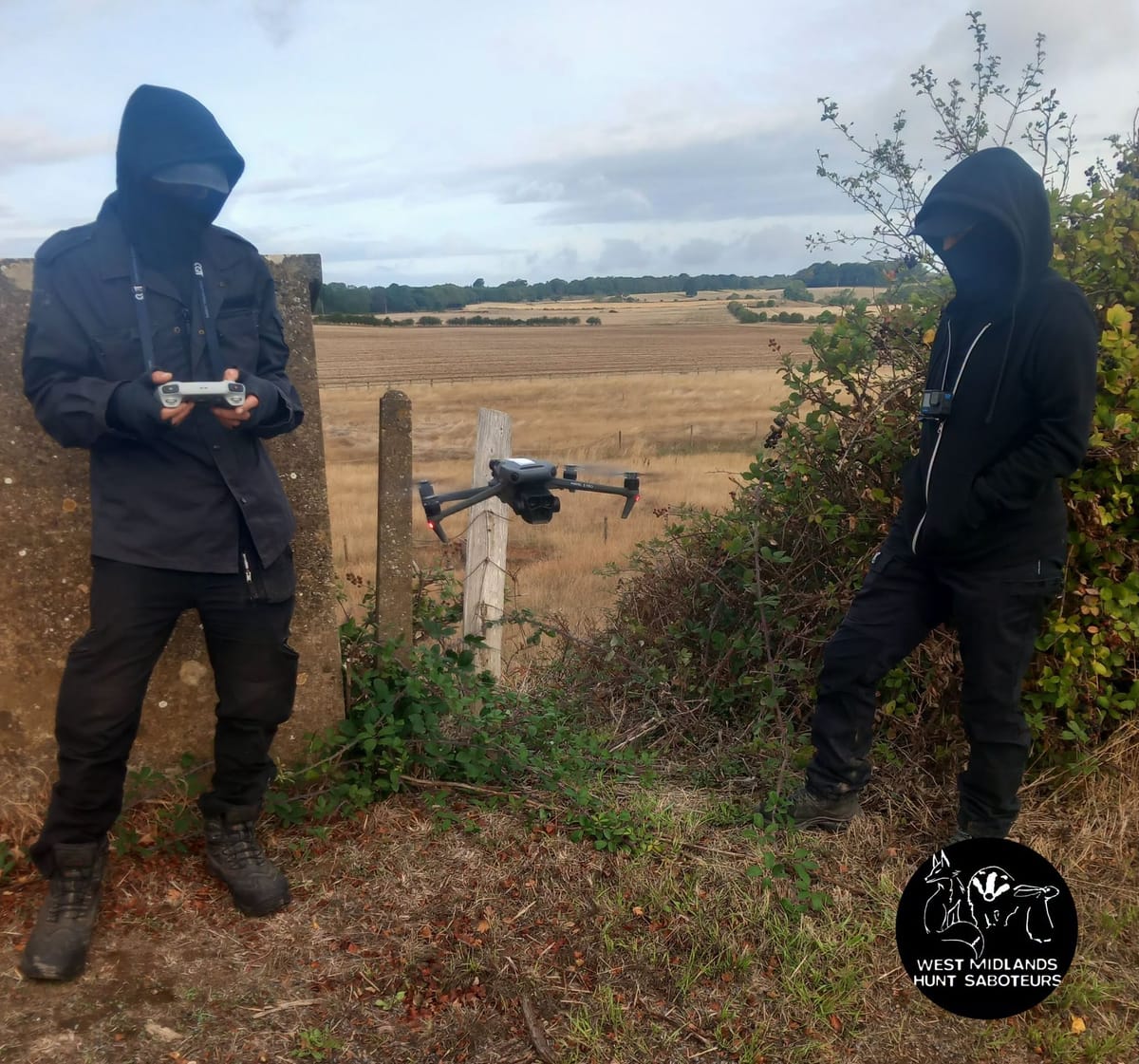
Dorset Police declined to send an officer after a drone, allegedly operated by hunt sabs, frightened a South Dorset Hunt horse into bolting and throwing its rider.
The incident happened on Saturday 7 November 2026. BTM understands the drone was operated by members of Weymouth Animal Rights. The rider was not seriously hurt but was badly shaken.
Kieran, one of the hunt’s masters, called Dorset Police. He told BTM he was informed that police had reviewed the incident and decided not to attend at that point. He was advised to email if he wished to pursue a complaint.
The horse belongs to Kieran and was meant to be his new hunt horse, but he said the incident had “really worked the horse up”. He also told BTM it was not the first time a drone had caused concern.
Kieran’s horse shortly after the drone incident, sweating heavily and breathing hard
A drone flown low over horses
Animal rights activists often describe their drones as monitoring equipment, used to record hunts. However, there is a difference between filming a hunt and flying a drone low over a mounted field.
A drone with a suitable camera can often record activity from further away. Flying close to horses risks frightening them, with potentially serious consequences for riders.
Anyone familiar with horses knows how quickly things can go wrong when one spooks. A bolting horse is difficult to control, and in open hunting country there are plenty of hazards: roads, wire fences, ditches, gates and other horses and riders.
A fall can have serious consequences. It is difficult to understand why flying a drone so close to a mounted field should be treated as an acceptable way of monitoring a hunt.
A drone flown low over the South Dorset Hunt field on 3 October
Why didn’t police attend?
The relevant law is not simply a question of whether someone is entitled to fly a drone. Under the Air Navigation Order 2016, it is an offence to recklessly or negligently cause an aircraft, including an unmanned aircraft, to endanger any person or property.
A horse bolting after a drone was flown low over mounted riders raises an obvious question about whether that provision should have been considered.
Police did not have to decide the matter from a desk. Under the Air Traffic Management and Unmanned Aircraft Act 2021, officers have the power to order a drone to land, demand to see the pilot’s registration and seize the drone if they suspect an offence. An officer could have attended, spoken to the rider and witnesses, established how close the drone had been flown and asked to see any available footage.
Instead, the incident was reviewed and police decided not to attend.
This is a troubling response. Whether the drone was flown recklessly or negligently is a matter that requires the circumstances to be established. It is difficult to see how that could be done without speaking to those who were there.
Two-tier policing?
Concerns about two-tier policing in the hunting world are not new.
In December 2024, The Telegraph reported on emails obtained by the British Hound Sports Association (BHSA) under Freedom of Information laws, exchanged between the League Against Cruel Sports and Temporary Assistant Chief Constable Matt Longman, then the National Police Chiefs’ Council lead on hunting.
In one email, Longman shared a Times article discussing allegations of two-tier policing and told the League he was “very happy with the article in terms of how policing has been represented”.
The article included comments from former defence secretary Ben Wallace, who had questioned whether Longman could police hunting impartially. The correspondence prompted criticism from the BHSA, whose managing director Oliver Hughes said many in hunting and rural communities felt that two-tier policing was prevalent in the countryside.
None of this establishes why Dorset Police decided not to attend on 7 November. But the decision, as described by Kieran, is another example that will do little to reassure those who believe the same standards are not always applied to both sides of the hunting debate.